


Thermal Night Vision Binoculars for Fast Motion Tracking
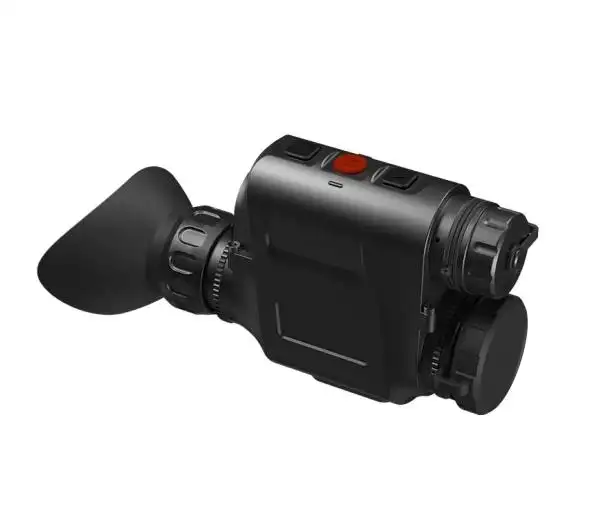
Thermal Night Vision Binoculars enable fast motion tracking in demanding night operations while preserving situational awareness. Their dual-eye stability reduces fatigue and sharpens choices in low light. This article clarifies what these systems are, how they differ from conventional night vision, and how a field-tested binocular platform enables confident tracking of mobile targets.
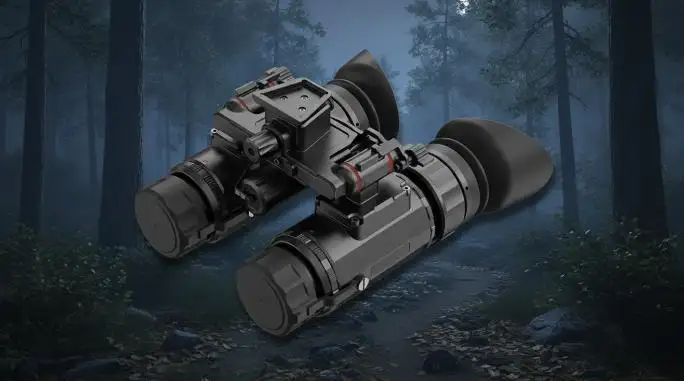
What Are Thermal Night Vision Binoculars?
The term Thermal Night Vision Binoculars is widely used in the field to describe binocular platforms that enable clear observation in darkness. In practice, the category spans two core approaches:
✅ Thermal imaging detects heat signatures in the long-wave infrared band.
✅ Image intensification amplifies available light in the visible and near-infrared bands.
Some advanced systems fuse both layers. Each path offers distinct benefits for tracking moving subjects.
- Core Technologies and the Meaning Behind the Name
Thermal imaging excels at detection. It reveals subjects with strong temperature contrast behind smoke, light foliage, or haze. It is robust to ambient light variation, yet fine texture and scene sharpness can be limited. Image intensification, by contrast, preserves edges, textures, and depth cues. It produces a naturalistic scene that supports precise recognition and orientation. Latency is minimal, which is valuable when subjects accelerate or change direction.
Modern binoculars in this class adopt high-performance GEN 2+ tubes with strong line-pair resolution for crisp detail at speed. Many users search for Thermal Night Vision Binoculars when their true need is dependable, low-latency recognition at night. For that requirement, a wid-view intensifier binocular often gives the operator a faster kill-chain from detection to identification.
How They Differ from Traditional Solutions
Traditional night tools include narrow-FOV monoculars, handheld spotlights, and consumer-grade digital viewers. Speed exposes the limits of conventional setups:
• Narrow optics compel continual sweep, producing tunnel vision.
• High-intensity light blows out highlights and harms dark-eye adaptation; digital imaging can introduce smear or delay.
✅ Thermal night-vision binoculars with broad FOV and a high-fidelity intensifier relieve the strain:
• 40° FOV reduces pan workload and sustains peripheral awareness.
• A robust GEN 2+ core maintains edge sharpness as targets cross the scene.
• When a scene drops below starlight, an integrated near-infrared illuminator at 850 nm provides controlled fill for shadowed zones.
• A high-light protection mechanism shields the tube from sudden glare, keeping the image stable and the system safe.
❓ Why Fast Motion Tracking Demands a Wider View?
Tracking at speed is a situational awareness problem before it is a magnification problem. Operators need to predict motion, not just see it. Wider FOV improves trajectory estimation and allows earlier interception of erratic paths. It cuts the number of micro-corrections and reduces fatigue. It also preserves context. Landmarks, team members, and hazards remain within the visual envelope. Dynamic urban transitions bring sudden lighting changes; quick adaptation keeps you effective. Bright-light safeguards and steady contrast management eliminate blooming from headlights or doorways. These traits allow Thermal Night Vision Binoculars to hold track continuity despite surprise conditions.
Engineering Thermal Night Vision Binoculars for Fast Motion Tracking
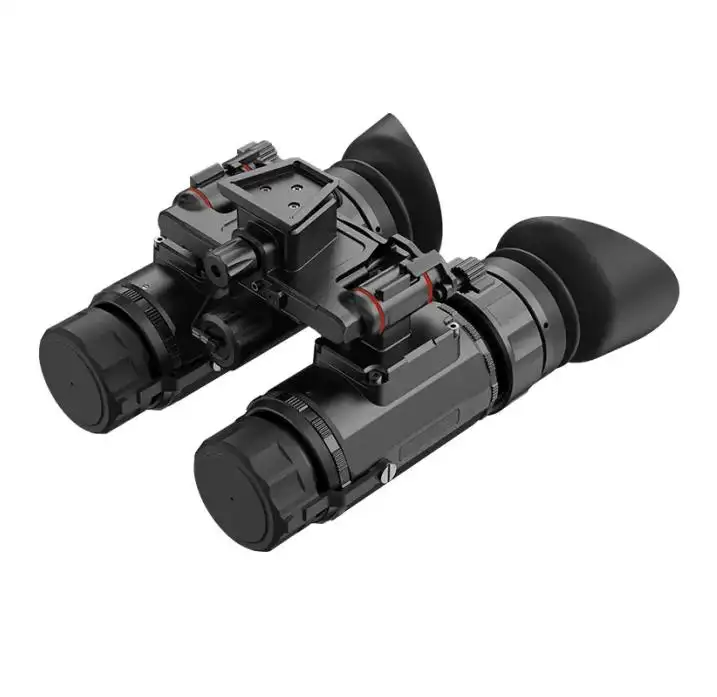
Designed for reliable performance and tim-critical observation. The chassis balances compact form with stability on the helmet or hand. Weather sealing supports all-weather patrols. Runtime spans full-shift deployments, decreasing battery exchanges in critical windows. The optical design favors a generous field while preserving fidelity, so operators can scan large sectors with fewer passes. The result is a platform that serves night patrol, wildlife monitoring, search operations, and perimeter defense with consistent performance.
u Key Specifications That Matter
The following data points define fast motion tracking performance and operational uptime in Thermal Night Vision Binoculars:
• 40° Field Of View: Wide coverage for fewer sweeps and tighter track continuity in cluttered scenes.
• GEN 2+ Image Intensifier (≥64 lp/mm): High spatial resolution that preserves fine edges and textures during rapid movement.
• 850 nm IR Enhancer: Near-IR fill evens exposure in deep shadow while keeping the scene natural.
• Bright-Light Management: Automatic bloom control keeps images usable through sudden glare.
• 20-Hour Service Time: Long-lasting operation for all-night patrols and staged mission sets.
• IP67 Housing: Dust-tight, water-resistant construction for wet and muddy conditions.
Collectively, they reduce operator workload and help keep errors to a minimum. Wide FOV lowers search time per sector. High-fidelity intensification reduces misidentification. Stable exposure and tube protection keep the view usable through harsh transitions. High-endurance operation preserves continuity and prevents gaps during high-tempo night tracking.
Seldom-Taught Essentials for Reliable Night Pursuit
• Keep Magnification At 1x: Protect spatial orientation and reduce motion amplification.
• Calibrate Diopters Carefully: Achieve uniform clarity across the field to shorten reaction time.
• Pr-Focus Discipline: Establish focus at typical engagement distances; nudge, don't crank, for fine clarity.
• IR Restraint: Apply 850 nm minimally; offset the beam to limit reflective splash nearby.
• Manage Sudden Light: Depend on bright-light protection and avoid direct headlight exposure.
• Purpos-Built Scanning: Combine S-shaped paths with vertical “ladder” sweeps to flag low, cross-movement.
• Sequential Track Method: Detect with thermal first, then handoff to intensifier for ID and persistent tracking.
• Train For Latency-Free Pursuit: Practice walking and running with the system to align vestibular cues and head movement with the visual feed.
u A Field-Proven Path to Faster Tracking
A field-proven binocular platform, built for all-night patrol and outdoor observation, aligns each feature with fast motion tracking.
• The 40° field of view reduces search friction and supports continuous, smooth pursuit. The GEN 2+ intensifier provides clean detail, maintaining edge contrast on clothing, tools, and obstacles.
• An integrated 850 nm IR illuminator recovers structure in deep shadows without heavy grain. With bright-light protection, exposure changes become manageable events rather than mission-stopping hazards.
• The 20-hour operating time and IP67 protection keep the system working through rain, dust, and long shifts without repeated battery swaps or protective covers.
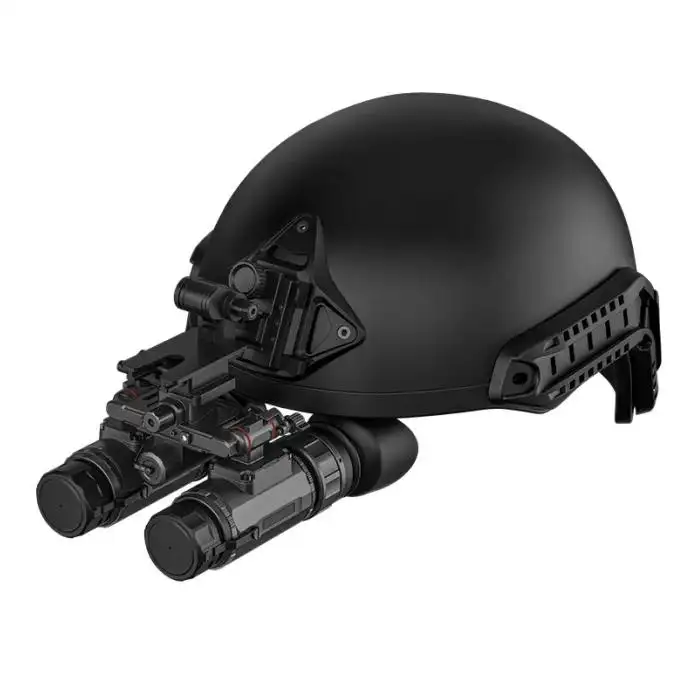
These design choices translate directly to outcomes.
• In perimeter security, operators maintain a stable lock on fast crossers without losing situational context at the edges.
• In search and rescue, responders scan wide corridors of terrain while jogging ridge lines and riverbanks.
• In wildlife observation, teams track erratic movement without startling animals with frequent light changes.
• Maritime teams benefit from the wide view and sealing, sustaining tracking while spray and wind complicate navigation.
These design choices translate directly to outcomes. Perimeter monitoring keeps fast crossers locked while preserving situational context in the periphery. SAR responders scan wide terrain corridors as they jog along ridges and riverbanks. Wildlife teams track erratic motion without spooking animals via abrupt light changes. Maritime crews use broad sightlines and sealed construction to maintain tracking through spray and gusty conditions.
u Deployment is Clear and Repeatable
• Fit The Mount And Balance: Dial helmet fit and counterweight for neutral head posture to limit neck fatigue.
• Dial In Optics: Configure IPD, then set diopters until fine detail stays sharp across the image.
• Choose Power Strategy: Leverage built-in endurance and a staged backup rather than frequent battery swaps.
• Set Illumination Rules: Set IR thresholds and approach angles to minimize bloom near reflective surfaces.
• Mobility Drills With Optics: Practice quick acceleration, stair ascents, and vehicle entries while maintaining an even binocular view to reduce fatigue and blur.
Call to Action
Looking for clearer, faster tracking at night? Try our Thermal Night Vision Binoculars. Book a live demo, coordinate a field trial, or connect with specialists on integration, mounting, and training best practices. Deliver a broad, low-latency perspective and turn rapid night movement into consistent success.
Share on Social:


- PREV: How Thermal Imaging Monocular for Hunting Speeds Target ID?
- NEXT: Not NEXT
