


Should You Launch an Entry-Level or Premium Night Vision Product First?




I've noticed that when people start talking about launching a new night vision product, the conversation can get very technical, very quickly.
Someone brings up image resolution. Someone else asks about magnification or low-light performance. Then the discussion moves to features, configurations, and of course, the price. Everyone has an opinion about what the product should offer. But I sometimes feel there's a question missing from the conversation: who is actually going to buy it?
I mean, there's no shortage of products in the market already. A brand can develop a basic night vision monocular and compete on price, or spend more on a higher-spec model and aim for a different group of customers. Neither sounds like a bad idea on its own. But I've always been a little curious about what happens when a brand chooses the product first and only starts thinking about its customers afterwards. It can make the whole process much harder than it needs to be.
Take an entry-level product, for example. It's easy to assume that a lower price means an easier sale. And if you're launching a brand for the first time, that assumption is understandable. But what if the product ends up looking just like dozens of other affordable devices? On the other hand, a premium model might have much better specifications, but will customers who don't know your brand yet be willing to pay that extra money? That's where I think the real discussion begins.
Starting with an Entry-Level Product Sounds Safe. Is It?
I can see why a new brand would lean towards an entry-level night vision device. The potential customer base is broader, and the price is usually less intimidating for someone buying their first device.
Imagine a customer who's interested in night-time outdoor activities or recreational games. They've never owned a night vision monocular before. They might not know much about sensor specifications or the differences between various infrared configurations. What they want is something that works, doesn't take too long to figure out, and doesn't cost a fortune.
A straightforward digital night vision device could be a good fit.
For a brand, this also makes the product easier to introduce. You don't need to spend half the sales conversation explaining technical details that a first-time buyer may not care about. The customer can understand the purpose of the device fairly quickly.
But here's something I wouldn't overlook: affordable products are everywhere. If your only selling point is a lower price, you're likely to find yourself competing with other brands doing exactly the same thing.
And price competition can become exhausting. There's always someone willing to offer a little less. If you keep lowering the price to stay competitive, sooner or later something has to give.
I've seen how easy it is to focus so much on the target price during product development that the actual user experience becomes an afterthought. A device may look attractive in a catalogue, but if the image quality is disappointing or the controls are awkward, customers won't care how much money the brand saved during manufacturing.
I don't think an entry-level model needs to be complicated. In fact, keeping things simple can be a real advantage. But the basic experience has to be there. If someone buys a night vision device for the first time, they should come away feeling that it was money well spent.
Going Premium: A Stronger Product Doesn't Always Mean an Easier Sale
Now, suppose a brand decides to go in the opposite direction.
Instead of trying to attract a wide audience, it wants to target buyers who already understand night vision equipment and are willing to pay more for better performance.
I actually think this can be a very interesting route, especially when the brand has a clear idea of which market it wants to enter.
Experienced buyers tend to ask different questions. They may want to know how a device performs in very low-light conditions, how much detail it can capture, and whether it can produce a usable image without relying on infrared illumination. They might also look closely at the sensor, lens, display, and other components.
For digital night vision products, these details can make a real difference to the user experience.
A product with stronger low-light performance, for instance, may appeal to customers who don't want to use IR illumination all the time. In certain situations, being able to observe without an additional infrared light source is a meaningful advantage.
But I wouldn't assume that every customer is looking for the highest possible specifications.
Sometimes, a product is technically impressive but simply doesn't match what the target market is prepared to pay for. A buyer might appreciate a particular feature during a product demonstration and still decide that it's not worth the extra cost for their customers.
There's also the brand recognition issue. If you're an established name, customers may already have a reason to trust your products. If you're a new brand, you're asking people to spend more money on a name they haven't used before. That's a different sales challenge.
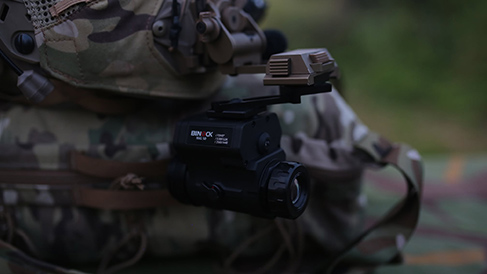
So, if I were considering a premium launch, I'd want to be very clear about what makes the product worth its price. Not just what components it uses, but what customers can actually do better with it.
A long specification sheet isn't going to answer that question on its own.
At Some Point, You Have to Think Beyond the First Product
Something else comes to mind when I look at this entry-level versus premium discussion: brands often spend so much time deciding what their first product should be that they don't think far enough ahead.
Let's say you launch an affordable night vision monocular. It gets some attention, and you start receiving feedback from distributors. Some are happy with the price and basic performance. Others ask whether you have a model with better low-light capability.
Or perhaps you launch a premium model first. It attracts a certain type of buyer, but a distributor later asks for a more affordable option that could sell through a wider retail network.
These situations aren't unusual in product planning. The first product can tell you quite a lot about the market, sometimes things you didn't expect before launching.
That's one reason I wouldn't treat the first SKU as a decision that defines the entire future of the brand.
There are different ways to build a product range. Some brands prefer to cover several price points, with entry-level, mid-range, and premium models. Others organize products around applications, because the needs of an Airsoft user can be quite different from those of someone buying equipment for outdoor observation.
And some brands choose to stay focused. They may only offer a few models, but each one has a fairly clear purpose.
Personally, I find the last approach quite sensible for a brand that's still developing its market. You don't need a huge catalogue just to look like an established supplier.
Think about Airsoft, for example. One customer may care more about how a device handles during a game, while another might be particularly interested in its performance in darker environments. Putting both customers into the same broad category doesn't necessarily mean they'll want the same product.
The same thing happens in outdoor markets. Some buyers prioritize portability and ease of use. Others are more interested in observation performance and specific technical features.
Once you look at the actual applications, the difference between products becomes much easier to understand. You're no longer adding models just to offer more choices. You're developing them because there's a reason for customers to choose one over another.
A Bigger Catalogue Can Create More Problems Than You Expect
I want to mention this because it's easy to get carried away when planning a new product range.
You look at competitors' websites and see all kinds of models. One has a different magnification option, another has a new display, and another comes with a slightly different configuration. Suddenly, your own catalogue starts to look a little small.
It's tempting to think you need to catch up.
But does your market actually need all those products?
I've always felt that every new SKU should have a clear reason behind it. Maybe the current model doesn't meet a particular customer's needs. Maybe there's enough demand for a more affordable version. Or perhaps a new feature would genuinely make the product more useful in a specific application.
Those are reasonable reasons to develop something new.
Copying a competitor's product range just because it looks successful is a different matter. You may end up spending time and money developing products that don't bring in enough additional business.
There's also quite a bit of work after development. Samples need testing, product images need preparing, sales teams need to understand the differences, and inventory has to be managed. If several models have very similar positioning, even the sales process can become confusing.
Sometimes I'd rather see a brand spend more time improving one existing model than rush into another launch. A small improvement that solves a real customer problem can be more valuable than a completely new product that nobody was asking for.
So, Which One Would I Choose First?
After all this, I don't think there's one answer that works for every brand.
If the target market consists mainly of first-time buyers, an entry-level product could be a sensible starting point. There's room to attract customers who are curious about night vision but aren't ready to invest heavily.
If the brand already has access to experienced buyers, understands their expectations, and can offer something that genuinely stands out, starting with a premium product is also a reasonable decision.
What I'd be more careful about is choosing a product simply because its price looks attractive or its specifications seem impressive.
Before making that decision, I'd want to spend some time looking at the brands already selling in the target market. What are they offering? Which products seem to have a clear purpose? Are customers asking for something that isn't being served particularly well? And where could a new brand realistically fit in?
You don't need to have the answers to every question before developing your first product. But having a general direction is much better than building something first and hoping the right customers will eventually find it.
At BINOCK, conversations about digital night vision products and OEM/ODM development often start with the intended market and application. It's a useful way to work out which product direction makes sense before getting too deep into specifications and configurations.

I've come to think that choosing the first product is really just the beginning. What matters more is whether that product gives the brand somewhere sensible to go next.
And I'd take a smaller product range with a clear purpose over a crowded catalogue any day.
Share on Social:


