


The Real-World Range of Digital Night Vision Goggles


If you are a procurement officer, a retail brand owner, or a tactical professional vetting a manufacturer for night vision goggles, you have likely been bombarded with range numbers that sound like science fiction. "500-yard detection!"
But as any veteran operator who has actually stood in a photon-starved forest will tell you: Range without a Lux rating is a marketing lie.
The Physics of Photon Hunger: SNR is Everything
Digital night vision isn't magic; it’s a high-stakes game of photon management. Unlike traditional analog tubes that use vacuum-sealed electron multipliers, a night vision camera sensor (typically CMOS) relies on its Quantum Efficiency (QE) to convert incoming photons into usable digital data.
When you peer through a night vision scope, your range is fundamentally capped by the Signal-to-Noise Ratio (SNR). Think of it like a radio: as the signal (light) gets weaker, you have to turn up the volume (gain). If the sensor is low-quality, you don't just get a louder signal; you get static. In the night vision world, that static is "electronic noise"—the dancing snow that obscures a target at 100 yards.
This is why a device that sees 300 yards under a full moon might be completely blind at 40 yards in a dense, clouded woodland. The sensor has simply run out of clean data to process.
The DRI Standard: The Metric That Separates Toys from Tools
Most consumer-grade night vision binoculars sold on massive e-commerce platforms use what I call "Marketing Distance." They give you the absolute best-case scenario Detection distance and hope you don't ask about Identification. In professional circles, we use the DRI standard:
- Detection (D): The ability to say "there is something moving." Most market CMOS units can detect a human-sized object at 300-400 yards under a half-moon. But at this range, is it a deer or a shadow? You have no idea.
- Recognition (R): The ability to distinguish between a coyote and a domestic dog. In real-world tactical environments, standard digital units lose this clarity past 120 yards.
- Identification (I): Positive Identification (PID). This is the gold standard. Can you see if the subject is holding a camera, a tool, or a weapon? Can you identify the specific species of an animal? Most budget CMOS devices on the market fail Identification past 60–80 yards.
At BINOCK, we optimize our signal processing and noise suppression architecture to push PID out to 150+ yards under 0.01 Lux conditions. If a supplier promises PID at 300 yards without a high-power external IR laser, they are conveniently ignoring the laws of physics.
Night Vision Goggle Variable Environment: Lux, Moon, and City Glow
The best night vision goggles are only as good as the photons available to them. Range is a sliding scale, not a static number. As a buyer, you must understand how your operational environment dictates your gear's performance:
The "Golden Hour" of Night Vision (Full Moon - 0.1 Lux)
Under a full moon, digital sensors excel. The high contrast allows the CMOS to capture crisp edges. In these conditions, you can often achieve high-contrast Identification at 250+ yards. This is where most manufacturers take their marketing photos.
The Tactical Threshold (Quarter Moon - 0.01 Lux)
This is the turning point. This is where high-end BINOCK optics pull away from the "cheap" competition. Lower-quality sensors will begin to "wash out" or become overly grainy here. To see past 100 yards, the quality of the glass (F-stop) and the sensor's pixel size become critical.
Total Darkness (Overcast/Deep Woods - 0.001 Lux)
Photon starvation. In these conditions, even the most expensive digital unit is a paperweight without an IR illuminator. Your range is now 100% dependent on the wattage and wavelength of your IR light.
The Urban Trap (Light Pollution)
City lights create "backglow." This can actually reduce your effective range because the high contrast between a bright streetlamp and a dark alleyway can cause "blooming," effectively blinding the sensor's ability to see into the shadows where a target might be hiding.
Optical vs. Digital: The Hidden Killer of Range of Night Vision Goggle
Many users assume that "Digital Zoom" helps them see further. In reality, it often does the opposite.
When you use the zoom feature on a night vision scope, digital zoom just enlarges the existing pixels. If your base image is grainy, zooming in just makes the grain larger. This is why night vision binoculars with optical magnification (moving glass) will always outrange head-mounted goggles with 1x magnification.
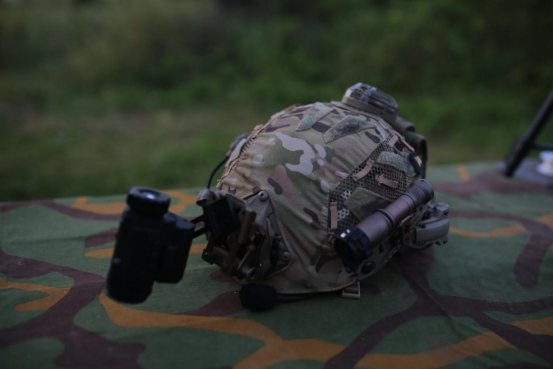
For helmet-mounted night vision goggles, you are trading range for situational awareness. If your mission requires identifying a target at 300 yards, a head-mounted goggle is the wrong tool; you need a handheld unit with a dedicated optical objective lens.
Pro Tip: The "Vendor Audit" Checklist
If you are purchasing for a government contract, a professional security firm, or a global distributorship, you cannot rely on a PDF spec sheet. You need to grill the manufacturer. Before you commit to a bulk order, ask these four questions:
- "Under what specific Lux level was this range achieved?" If they can't define the light level (e.g., 0.05 Lux), the number is a guess.
- "What is the Signal-to-Noise Ratio (SNR) at maximum gain?" A professional manufacturer will have this data from their sensor lab.
- "Was the testing done with built-in IR or an external 5W laser?" Don't let them hide behind a high-power spotlight that isn't included in the package.
- "What is the Aperture (F-stop) of the objective lens?" A lens with an F1.2 aperture lets in twice as much light as an F2.0. If the factory doesn't know their F-stop, they aren't optics experts—they are just assemblers.
The "Glass" Factor: Why Coatings Matter
Range isn't just about the electronics; it’s about how many photons actually reach the sensor. Standard glass reflects about 4-5% of light per surface. In a multi-lens system, you could lose 30% of your range before the light even touches the CMOS.
At BINOCK, we use multi-layered broadband coatings (FMC) designed specifically for the infrared spectrum. By reducing reflection and increasing light transmission to over 98%, we effectively "buy" back the range that cheaper devices lose to poor glass quality.
Operational Context: Hunting vs. Security vs. Airsoft
The Long-Range Hunter
For coyote or feral hog control, you aren't just looking for movement; you are looking for a clean, ethical shot. This requires Positive Identification at 200 yards. To achieve this digitally, you must prioritize a high-wattage 850nm IR illuminator and a sensor with high dynamic range to handle the IR "washout" on nearby foliage.
The Security Professional
In surveillance, range is about proactive detection. You need to see the "ghost" at 400 yards so you can prepare before they reach the 50-yard "danger zone." Here, wide-angle night vision goggles are paired with static, long-range thermal cameras for the ultimate defensive perimeter.
The Airsoft Enthusiast
In close-quarters night games, range is secondary to latency. You need to see the tripwire at 5 feet and the opponent at 50 yards. The "Best night vision goggles" for Airsoft are those with a high refresh rate (40Hz+) and 1x magnification to maintain depth perception.
Why BINOCK Stays Ahead of the Curve
We are not a trading company; we are a specialized R&D powerhouse based in Sichuan. Our 6,000-square-meter facility is dedicated to solving the SNR problem. By controlling the entire process—from mold development to PCB shielding—we ensure that our night vision camera systems don't just work; they dominate.
We hold over 178 patents because we know that the difference between a successful mission and a failure often comes down to the last 10 yards of identification range.
The Final Verdict of Night Vision Goggle
So, how far can digital night vision see? Under the right conditions, a BINOCK professional-grade system can detect movement at 500 yards and provide Identification at 150-200 yards. But remember: the dark is an unforgiving environment. It doesn't care about marketing claims—it only cares about physics, glass, and photon efficiency.
If you’re ready to stop guessing in the dark and start seeing the reality of the night, explore the BINOCK Professional Collection. Don't just follow the light; master the dark.iggest number on the spec sheet. It’s about matching the tool to the task. If you’re ready to stop guessing in the dark and start seeing, check out our full lineup. We built them for the real world.
Share on Social:


