


Why Do Animals See Better at Night Than We Do? Do They Have Built-In Night Vision?


I've always found walking the dog at night a little strange.
Sometimes, the street is so dark that I'm barely able to see what's ahead of me. Then my dog suddenly stops and stares into a patch of bushes like it's just discovered a major secret.
Naturally, I look in the same direction.
Nothing.
I look again, just in case.
Still nothing.
At this point, it's hard not to wonder: Is my eyesight that bad, or has my dog spotted something I can't see at all?
Cats are no less mysterious. During the day, mine might spend hours looking like the most uninterested creature on the planet. But at night? Suddenly, it's jumping onto shelves, weaving between furniture, and racing through the house as if it has a complete map of every corner stored in its head.
Meanwhile, I'm trying not to step on anything.
How do some animals move around so confidently in low light when we can barely see where we're going? Do cats and owls have some kind of built-in night vision? And if their eyes are so good at seeing in the dark, why didn't humans develop the same ability?
As it turns out, there's quite a bit going on behind those impressive animal eyes. And the answer isn't simply that animals have better eyesight than we do.
Not Every Animal Is a Night Vision Expert
When we talk about animals that can see in the dark, cats and owls usually come to mind first.
But the animal kingdom isn't exactly a competition to see who has the best eyes.
Different animals live different lives, and their visual systems have evolved to meet different needs.
Cats need to spot potential prey in dim environments. Many owls are adapted to hunting at night. Some birds, on the other hand, are much more active during the day and have visual abilities suited to brighter conditions.
Humans aren't completely helpless in the dark, either. Spend some time in a dim room, and your eyes gradually adjust. Eventually, you may start making out furniture, doorways, and other shapes that were almost impossible to see when you first walked in.
We're just not particularly good at seeing fine details when the light level gets very low.
The interesting part is that nature hasn't given every species the same set of equipment. An ability that's essential for one animal might be much less important for another.
So rather than asking which animal has the best eyes overall, it's more useful to ask which animals are especially good at using the limited light available at night.
And cats are a great place to start.
What's So Special About a Cat's Eyes?
1. Their pupils can change dramatically with the light
Have you ever looked at a cat in bright daylight and noticed that its pupils have narrowed into thin vertical slits?
Later, when the light gets dimmer, those pupils can open up considerably.
It's not just a dramatic look. The change serves a purpose.
The pupil controls how much light enters the eye. In bright conditions, it becomes smaller. In dim conditions, it expands, allowing more light to enter.
Humans have the same basic mechanism, but cats can show a much more dramatic change in pupil shape and size.
Think of it as an adjustable window. When the room gets darker, opening the window lets more light in.
Of course, a larger pupil doesn't solve every problem. It's only one part of the cat's visual system. The retina and its light-sensitive cells also play important roles in how well the animal can see in dim conditions.
In other words, cats don't rely on one magical feature to navigate the dark. Several parts of their eyes work together to make better use of limited light.
2. Why do cat eyes glow in the dark?
This is probably one of the most familiar things about cats at night.
You shine a flashlight toward a cat, and suddenly its eyes seem to light up. Sometimes the effect is bright enough to look like something straight out of a horror movie.
No, cats don't have tiny light bulbs hidden behind their eyes.
Many cats have a reflective layer behind the retina called the tapetum lucidum. It reflects some of the light that passes through the retina, giving the light-sensitive cells another opportunity to use it.
It's a bit like getting a second chance to make use of the same limited resource.
This reflective layer is one reason a cat's eyes can appear to glow when light hits them at certain angles. Humans don't have the same structure, which is why our eyes don't produce the same effect under ordinary conditions.
But there's an important catch: glowing eyes don't mean an animal can see in complete darkness.
The reflective layer helps make use of available light. It doesn't create light out of nothing.
So if your cat seems to be moving around a pitch-dark room without a problem, its eyes might not be doing all the work. Familiarity with the room, hearing, and other sensory information can also help it navigate.
3. Can cats actually see better than humans?
That depends on what we mean by better.
In dim conditions, cats are generally better equipped than humans to make use of limited light. But that doesn't mean they win at every kind of visual task.
Humans have rich color vision and can distinguish many subtle differences in color. Cats have more limited color discrimination, and their vision isn't designed to outperform ours in every situation.
A cat's eyes aren't simply human eyes with a nighttime mode switched on. They're part of a visual system adapted to the way cats live.
Their advantage becomes especially useful when the light starts to fade.
But cats aren't the only animals with impressive nighttime abilities. Some hunters have another useful tool that doesn't depend on eyesight alone.
Owls Don't Just Rely on Their Eyes
When I think of an owl, I immediately picture those large, round eyes. They're practically the animal's signature feature.
And there's a good reason many nocturnal owls have eyes adapted to low-light conditions: they need to find prey when there's much less light available.
Different owl species have different abilities, of course, so it's not quite right to assume every owl sees equally well at night.
But here's another part I find even more interesting: their hearing.
For some owls, sound is an important clue when locating prey. In certain species, differences in ear placement and the structure of the facial feathers help them work out where a sound is coming from.
Imagine a small animal moving through grass at night.
You might not notice anything at all. An owl, however, can use information from its hearing, along with what it can see, to help locate the animal.
That doesn't mean owls can close their eyes and hunt with perfect accuracy. Their abilities vary by species and situation, and vision still matters.
The bigger point is that nighttime activity isn't always just about having better eyesight.
Sometimes, animals make up for limited visual information by relying more heavily on other senses.
And that raises another question: if animals are so well adapted to darkness, are there still situations where they struggle to see?
Even Animals Have Their Limits in the Dark
We tend to imagine that once night falls, animals like cats and owls simply switch into some kind of all-seeing mode.
Real life is less dramatic.
Even animals with excellent low-light vision need some usable light to form a visual image. Moonlight, starlight, and other sources of ambient light can all affect what they are able to see.
As the available light decreases, their vision becomes more limited, too. Depending on the situation, they may rely more on hearing or smell, change their behavior, or wait for conditions to improve.
There's a big difference between very low light and no usable light at all.
Being good at seeing in dim conditions doesn't mean being able to see everything in absolute darkness.
This distinction matters beyond the animal world, too. Many night vision technologies also rely on available light, while some can use near-infrared illumination to help produce an image when conditions are especially dark.
Which brings us to humans.
If we didn't evolve eyes like cats or owls, how do we manage to observe things at night?
Humans Don't Have Cat Eyes. So We Built Tools Instead.
Humans might not have the same low-light advantages as some nocturnal animals, but we're pretty good at finding other ways to solve problems.
A flashlight is the simplest example. Instead of relying entirely on the light already present, we add our own light source and use our eyes to observe what's around us.
Night vision devices take a different approach.
Traditional image-intensifier night vision collects available light and amplifies the resulting image signal, making it easier to observe scenes that would otherwise be difficult to see. Digital night vision uses electronic sensors to capture image information, which is then processed and displayed.
Neither approach gives us actual cat eyes. Instead, the technology helps us obtain visual information that our unaided eyes might struggle to pick up.
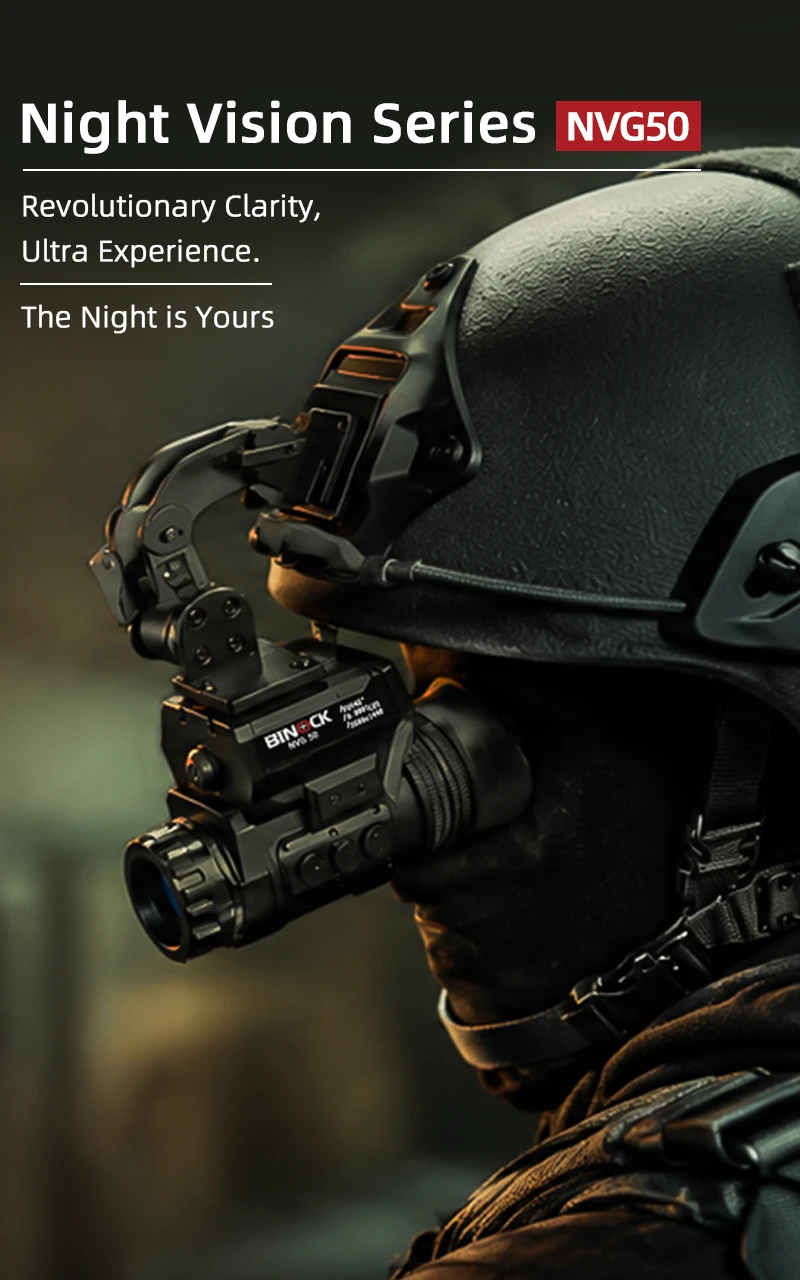
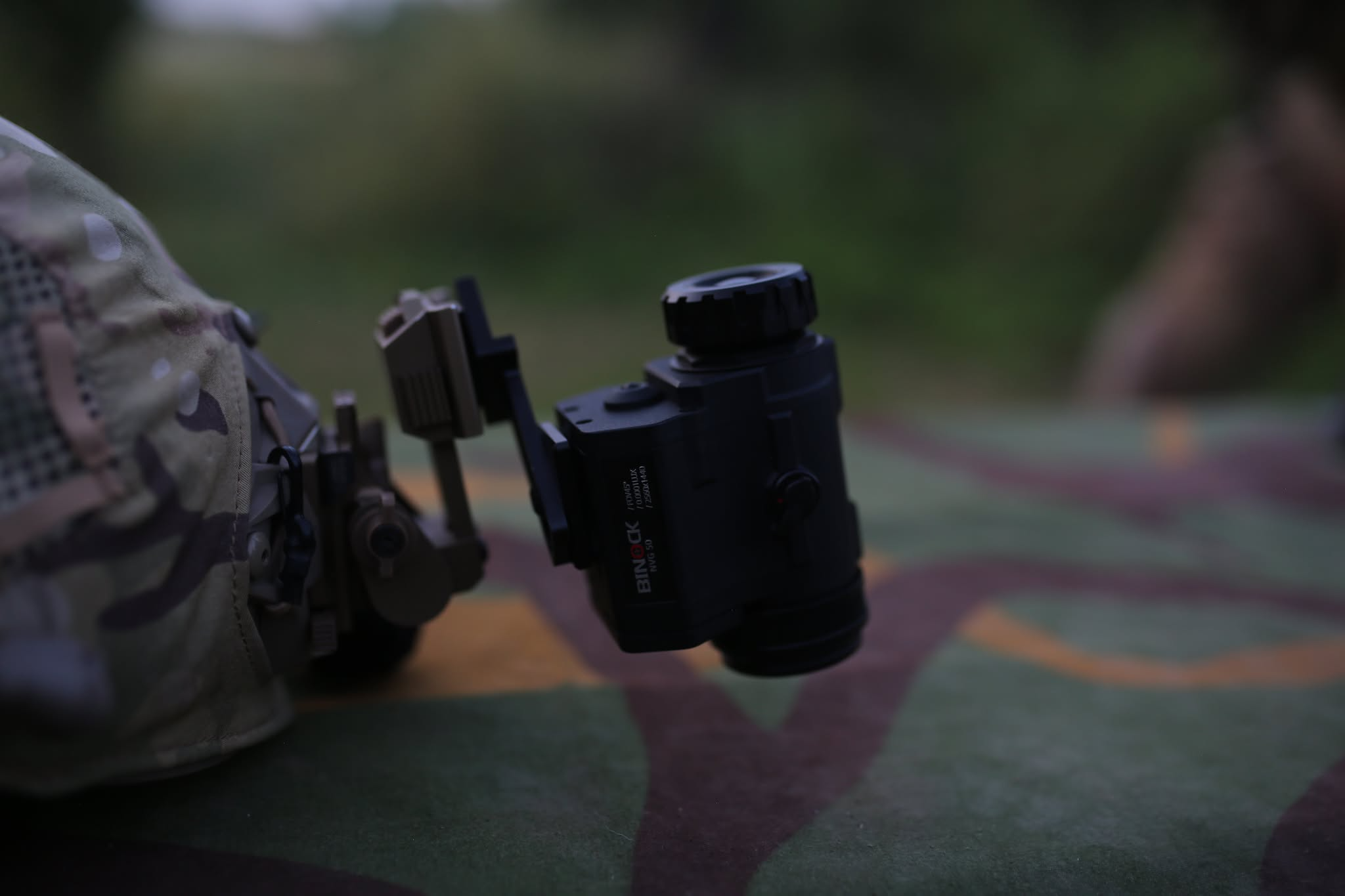
For example, the BINOCK NVG50 night vision monocular is a digital night vision device featuring a 2K, 2560 × 1440 image sensor. It also offers several display modes, including phosphor green, black and white, white phosphor, and full color.
I find that contrast pretty interesting.
We've spent a good part of this article talking about why night vision is so often associated with green images. Yet a digital device can offer several ways to display what it captures.
That's a useful reminder that the familiar green image isn't a rule every night vision device has to follow.
Of course, different display modes don't guarantee the same performance in every environment. Image quality still depends on factors such as ambient light, the sensor, illumination, and image processing.
If you're curious about how digital night vision devices capture and display images in low-light conditions, you can take a closer look at the NVG50's product details.
Night Vision and Thermal Imaging Aren't the Same Thing
There's one more distinction worth mentioning, because the two technologies are easy to mix up.
Sometimes we see a green or black-and-white image and call it night vision. Then we see footage with bright orange, yellow, and red areas and assume it's just another type of night vision display.
But night vision and thermal imaging work differently.
Traditional image-intensifier night vision amplifies available light. Digital night vision captures and processes image information using electronic sensors.
Thermal imaging, on the other hand, detects infrared radiation emitted by objects and converts that information into an image.
That's why a person might appear orange or red in a thermal image even if they're wearing ordinary-colored clothing. Those colors represent information about the detected infrared radiation, rather than the actual colors of the objects.
It's easy to focus on what an image looks like and overlook how it was created. But the underlying technology makes a real difference.
If you'd like to explore the differences in more detail, take a look at our article, Thermal Imaging vs. Night Vision: Which One Should You Choose for Your Market?
Maybe Animals Don't Just See More. Maybe They Experience the Night Differently.
Let's go back to that dog staring into the bushes.
The next time it happens, I might still look in the same direction and see absolutely nothing.
Maybe my dog noticed a tiny movement I missed. Maybe it heard something rustling in the grass. Just because it's staring at something doesn't mean I can know exactly what it has detected.
And that's what makes animal perception so fascinating.
We tend to judge the world through our own eyes, ears, and experiences. It's easy to forget that other animals can gather information in very different ways.
Some are better at making use of weak light. Others rely on remarkably sensitive hearing to locate prey. Many combine several senses to navigate their surroundings and survive after dark.
Humans may not have evolved cat-like eyes, but we've found other ways to deal with our limitations, from simple flashlights to night vision devices and thermal imaging systems.
We haven't turned our eyes into the eyes of another species. We've learned to observe the world in different ways.
So the next time your cat races across the room in the middle of the night, or your dog suddenly stops to stare at an apparently empty patch of grass, remember this:
Night doesn't look the same to every living thing. Different eyes—and different senses—can reveal very different worlds.


