


What Does “1000m Detection Range” Actually Mean?


If you've ever looked at a thermal imaging product specification sheet, you've probably noticed a number like this:
Detection Range: More than 1000m
Sounds impressive.
But there’s a very common assumption that comes with that number:
“So… it can clearly see things from more than 1000 meters away?”
Well…
Not exactly.
If thermal imaging devices could talk, this is probably where they would interrupt and say:
“I said detection, not identification.”
😂
And that small difference actually matters quite a lot.
Detection, Recognition, and Identification are three different things.
So when you see “Detection Range: 1000m,” the better question isn't:
“Can it see clearly at 1000 meters?”
It's:
“What does ‘detection’ actually mean?”
What Is a Thermal Imager Actually Looking At?
Let's start with the basics.
When you use your phone camera or a regular digital camera, you're working with visible light.
You see a tree because light reaches the tree, reflects from its surface, and eventually reaches your eyes or the camera.
That's why a conventional camera captures things we're familiar with:
Color.
Shape.
Texture.
Brightness.
Details.
In simple terms, a normal camera is mostly helping you understand:
“What does this thing look like?”
Thermal imaging works differently.
Instead of relying on visible light, it detects differences in thermal radiation and turns that information into an image.
So a thermal imager isn't necessarily asking:
“What does that object look like?”
It's first asking:
“Is there a meaningful thermal difference here?”
That's why thermal images can sometimes look so strange compared with what our eyes see.
A tree, a rock, a vehicle, or a person doesn't necessarily appear according to its normal color or appearance.
Instead, the scene is presented through differences in thermal characteristics.
So you could think of it this way:
Conventional imaging asks, “What does it look like?”
Thermal imaging starts by asking, “Is there a thermal difference here?”
And that difference is the whole point.
1000m Detection Does Not Mean “1000m Clear”
Now we get to the important part.
Thermal imaging specifications often use three terms:
Detection
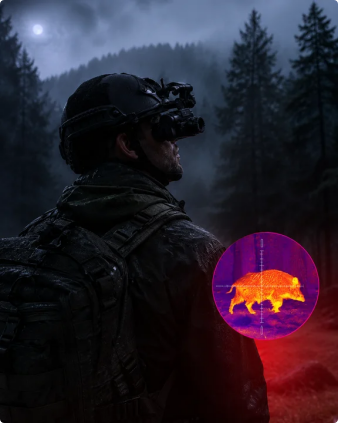
“There is something there.”
This is the first step.
The system can detect a thermal target against its background.
You may be able to say:
“There is a heat source over there.”
But that doesn't necessarily tell you exactly what it is.
Recognition
“I have a good idea what it is.”
At this stage, you have more information to work with.
The target's approximate shape, size, thermal characteristics, and surrounding environment may help you determine what type of object you're looking at.
You've moved from:
“There is something.”
to:
“I have an idea what it is.”
Identification
“I can determine what it is more specifically.”
This is a further step.
It requires more useful information and more detail from the image.
So the three stages can be simplified like this:
Detection:
There is something.
↓
Recognition:
I have an idea what it is.
↓
Identification:
I can determine what it is more specifically.
These aren't interchangeable terms.
So when a thermal imaging device is specified with:
Detection Range: More than 1000m
the specification primarily refers to the first step.
It does not mean that everything beyond 1000 meters can be clearly identified.
And that distinction is worth remembering.
Then What Is the Point of a 1000m Detection Range?
A very good question.
Because someone might look at this and think:
“If 1000m doesn't mean I can clearly identify something at 1000m, why does the number matter?”
It absolutely matters.
For many thermal imaging applications, detecting a target in the first place is already valuable information.
Imagine looking across a large area.
With conventional vision, the distance may simply look like:
“Just darkness.”
A thermal imager may instead show you:
“Wait. There's a noticeable heat source over there.”
That's already useful.
The system has done one of the most important things thermal imaging is designed to do:
help you notice thermal information that may otherwise be difficult to see.
So Detection Range isn't a meaningless marketing number.
The important thing is to understand what it actually describes.
Think of it less as:
“How far can I see everything clearly?”
and more as:
“Under suitable conditions, how far away may the system detect a thermal target?”
That's a much more accurate way to read the specification.
Why Can Two Products Both Claim “1000m” and Still Perform Differently?
This is where things get especially interesting for B2B buyers.
Imagine you have two product sheets:
Product A
Detection Range: 1000m+
Product B
Detection Range: 1000m+
Does that mean they're basically the same?
Of course not.
If product sourcing were that simple, we'd all have a much easier job.
😂
Detection range shouldn't be viewed in isolation.
A thermal imaging system is made up of multiple components and specifications that work together.
For example:
- Sensor resolution
- Pixel size
- Field of view
- Magnification
- Frame rate
- Lens and optical system
- Environmental conditions
- Target size and thermal contrast
In other words:
Detection Range is an important number, but it isn't a standalone number.
So, What Does 384 × 288 Resolution Tell You?
Let's take BINOCK BTI10 as an example.
The BTI10 uses a 384 × 288 thermal sensor.
At a basic level, the sensor needs to convert thermal information into image information.
The 384 × 288 specification describes the amount of spatial information provided by the sensor.
That doesn't mean:
“Higher resolution automatically equals longer detection range.”
Real-world performance is more complicated than that.
But resolution is still an important part of understanding how much image information a thermal imaging system can provide.
So if you're sourcing a thermal imaging product and you see:
Detection Range: 1000m+
don't stop there.
Take a look at the sensor resolution, too.
What About 12μm?
The BTI10 also uses a 12μm pixel size.
If you're new to thermal imaging, this number can look a little mysterious.
Pixel size, or pixel pitch, refers to the size of individual pixels on the thermal sensor.
It's an important part of sensor design and works together with factors such as the sensor, lens, and overall optical system to influence the product's performance.
And this is where thermal imaging gets interesting:
A product's performance rarely comes down to one magic number.
It's more like a team.
Sensor. Lens. Pixel size. FOV. Frame rate.
They all have a role to play.
So if a supplier simply tells you:
“Our thermal imager has a detection range of more than 1000 meters.”
You can politely follow up with:
“And what about the sensor?”
That's when the conversation usually gets more interesting.
Field of View: Seeing Far Isn't the Same as Seeing Wide
The BTI10 has a 16° × 11° field of view.
FOV, or Field of View, describes how much of the scene the system can cover at once.
It's a completely different concept from detection range.
A thermal imager may have a long detection range while still showing a relatively limited portion of the surrounding scene at one time.
So:
Seeing farther doesn't automatically mean seeing wider.
That's another reason not to judge a product by its most impressive-looking number.
The overall viewing experience comes from multiple specifications working together.
Does 8× Magnification Mean 8× the Detection Range?
The BTI10 offers:
1× / 2× / 4× / 8× magnification
And here's another very natural assumption:
“So if it has 8× magnification, does that turn a 1000m detection range into 8000m?”
If only it were that simple.
😂
That's not how it works.
Magnification changes how the target is displayed in the image. It does not simply multiply the detection range by the same factor.
So:
8× ≠ 8× Detection Range
Magnification is one part of the overall system.
It needs to be considered alongside the sensor, lens, field of view, and other optical characteristics.
Again, the same lesson applies:
One number rarely tells the whole story.
And What Does 50Hz Actually Do?
The BTI10 has a 50Hz frame rate.
Frame rate describes how frequently the image is updated.
Thermal imaging isn't simply about taking one still picture and displaying it.
When you're observing a moving scene, the frequency at which the image updates can affect how smooth the viewing experience feels.
But once again:
50Hz does not mean 50× the detection range.
😂
You may be noticing a pattern here.
A lot of thermal imaging specifications are perfectly real.
It's just surprisingly easy to misunderstand what they actually tell you.
So, How Should You Read “1000m Detection Range”?
If we had to simplify the whole idea, it would look like this:
Detection
“There is something.”
You detect a thermal target.
↓
Recognition
“I have an idea what it is.”
You can make a more informed judgment about the type of target.
↓
Identification
“I can determine what it is more specifically.”
You have enough information to make a more detailed determination.
And:
“Detection Range: More than 1000m” primarily describes the first step.
It does not automatically guarantee the other two.
As distance increases, the amount of information available from the target can decrease. Target size, thermal contrast, weather, background conditions, optics, sensor performance, and other factors can all affect the final result.
So instead of simply asking:
“How far can it see?”
a more useful question is:
“What kind of information can it provide at that distance?”
Those are two very different questions.
Putting the Numbers Together: The BINOCK BTI10
Now let's take another look at the BTI10 specifications.
| Specification | BTI10 |
| Detection Range | More than 1000m |
| Sensor Type | Uncooled |
| Sensor Resolution | 384 × 288 |
| Pixel Size | 12μm |
| Field of View | 16° × 11° |
| Magnification | 1× / 2× / 4× / 8× |
| Frame Rate | 50Hz |
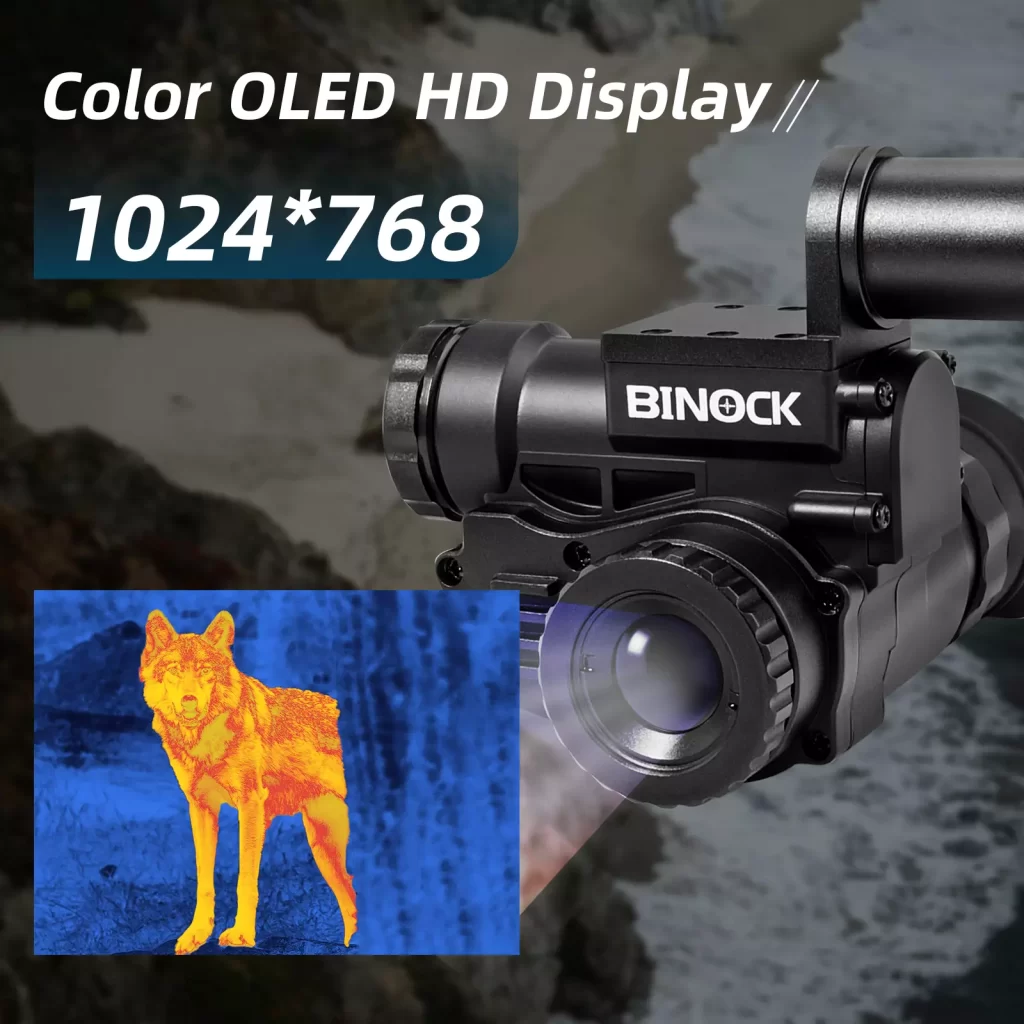
| Display | 1024 × 768 HD OLED |
| Image Modes | Black Hot / White Hot / Red Hot / Fusion |
Now the specification sheet starts to make a little more sense.
1000m+ Detection Range tells you about the system's long-distance thermal detection capability.
384 × 288 describes the sensor resolution.
12μm is an important part of the thermal sensor design.
16° × 11° FOV tells you about the viewing area.
1× / 2× / 4× / 8× provides different levels of image magnification.
50Hz describes the image update rate.
And the 1024 × 768 HD OLED is what ultimately presents all that thermal information to the user.
These specifications don't exist separately.
They work together.
And that's why a “1000m” detection range is never really just a story about one number.
If You're Sourcing Thermal Imaging Products, Don't Just Ask “How Far?”
If a supplier tells you:
“This thermal imaging device has a detection range of more than 1000 meters.”
Sure, write it down.
But don't stop there.
You can also ask:
What sensor does it use?
What is the resolution?
What is the pixel size?
What is the field of view?
What is the frame rate?
What kind of optical system supports that detection range?
And perhaps most importantly:
What market is this product actually designed for?
Because for B2B buyers, the goal isn't necessarily to find the product with the biggest number on every line of the specification sheet.
It's to find a product with:
a sensible specification combination,
a clear market position,
and the right capabilities for the customers you're trying to reach.
1000m Isn't the Answer. It's the Beginning of the Question.
So the next time you see:
Detection Range: More than 1000m
don't automatically translate it into:
“It can see everything clearly at 1000 meters.”
A more accurate interpretation would be:
Under suitable conditions, the thermal imaging system may detect a thermal target at distances beyond 1000 meters.
What happens after that depends on much more.
Can the target be recognized?
How much detail can the image provide?
What are the environmental conditions?
What are the target's size and thermal characteristics?
How do the sensor and optical system work together?
Those are the questions that tell you much more about the actual product.
Because when it comes to thermal imaging:
Detection, Recognition, and Identification are three different things.
And for anyone sourcing thermal imaging products, the more useful question may not be:
“How far can it detect?”
but:
“What information can it actually give my market?”
That question is usually a lot more valuable than a single impressive number.
Share on Social:


- PREV: When More Specs Don't Mean a Better Product
- NEXT: Not NEXT
