


When More Specs Don't Mean a Better Product




There’s one sentence you’ll probably hear quite often when talking to a supplier:
“We can add that feature, too.”
Need another coating? Sure.
Want more brightness levels? Probably doable.
A different battery? No problem.
A slightly different housing? Let’s discuss it.
On paper, this sounds great. A product with more features, more options, and a longer specification sheet must be a better product, right?
Well… not necessarily.
Sometimes, the hardest part of product design isn’t figuring out what else you can add.
It’s figuring out what doesn’t need to be there in the first place.
And this is where optical products, including red dot sights, become pretty interesting.
A Longer Spec Sheet Doesn't Automatically Mean a Better Product
When sourcing a new product, it’s very easy to get attracted to numbers.
More magnification.
More adjustment levels.
More functions.
More accessories.
More “upgrades.”
The specification sheet gets longer, and suddenly the product looks more sophisticated.
But a specification sheet answers one question:
What does this product have?
It doesn’t necessarily answer the more important question:
Why does the user need it?
That distinction matters a lot in B2B sourcing.
Because you’re not buying a collection of specifications.
You’re buying a product that needs to make sense for a particular market, price point, customer group, and sales channel.
And sometimes, adding one more feature makes the product more complicated without making it more useful.
Take 1× Magnification, for Example
Red dot optics are a pretty good example of how simplicity can actually be intentional.
A product like the BINOCK TD01 uses 1× magnification.
At first glance, someone who is used to comparing optical products might think:
“Only 1×? Isn’t more magnification better?”
Not really.
Magnification and product quality aren't the same thing.
A 1× optical design has a very different purpose from a magnified optic. The idea isn't to keep adding magnification just because the number sounds more impressive.
It’s about keeping the viewing experience straightforward and the product compact.
In other words, 1× isn't a missing feature. It is part of the product concept.
That’s an important distinction when you’re sourcing products.
Sometimes a product is doing exactly what it was designed to do.
It just isn't trying to win a specification competition.
Then There’s Brightness Adjustment
The same thing happens with brightness settings.
The TD01 offers 10 brightness levels, from 1 to 10.
That sounds pretty good on a specification sheet.
But imagine a supplier telling you:
“We can make 20 levels instead.”
Okay.
And then?
Would the average customer suddenly feel that their life has changed?
Probably not.
Nobody is sitting at their desk thinking:
“Everything is fine, but if this product had 17 brightness levels instead of 10, I would finally be happy.”
The important question is not simply how many levels there are.
It’s whether the available adjustment gives users enough flexibility for the environments and situations the product is designed around.

More settings can be useful.
But more settings can also become something that looks impressive in a product listing while making very little difference to the actual experience.
That’s the kind of detail B2B buyers need to look beyond.
Some of the Important Things Are Almost Invisible
Here’s another funny thing about optical products:
Some of the features customers care about most aren't necessarily the ones they notice immediately.
Take FMC lens coating.
You can't look at a product photo and say,
“Ah yes, excellent FMC coating.”
It isn't like a colorful housing or a fancy control that immediately catches attention.
But lens coating is part of the optical design and can influence light transmission and the overall viewing experience.
This is why a good specification sheet is useful—but only when you understand what the specifications actually mean.
A list of technical terms isn't automatically helpful.
Understanding the technical terms is.
Waterproofing Is Another Good Example
The TD01 is rated IPX7 for waterproof protection.
Again, it's tempting to treat this as a simple numbers game:
IPX7 sounds better than IPX5.
Great.
Move on.
But from a product-development and sourcing perspective, the more useful question is:
What level of environmental protection makes sense for the market you're selling to?
A product intended for outdoor use may need a different level of protection from one designed primarily for indoor or controlled environments.
The right specification depends on the product's positioning.
And that's something worth remembering when comparing suppliers.
You don't necessarily need the highest number on every line.
You need the right number for the product you're trying to build.
Small Doesn't Mean Simple
The TD01 is also relatively compact.
It weighs about 66.2g and measures approximately 4.4 × 2.7 × 3.9 cm.
Those numbers may look simple, but compact products are often much harder to design than they appear.
When you have plenty of space, you can spread components out.
When you don't, every millimeter starts to matter.
You have to think about structure, component placement, controls, optical performance, durability, weight, and manufacturing consistency.
So when you see a small optical product, “small” shouldn't automatically translate to “simple.”
Sometimes it's quite the opposite.
Small products can involve a lot of decisions that users never see.
And honestly, that's often a sign of good product design.
The Hard Part Is Knowing What Not to Add
This is probably one of the biggest differences between simply making a product and actually designing one.
Adding something is easy.
“Can we add another function?”
“Can we add another color?”
“Can we add another adjustment?”
“Can we add another accessory?”
In many cases, the answer is yes.
But that doesn't mean the answer should always be yes.
Every additional feature can affect cost, assembly, quality control, packaging, inventory, user experience, and eventually the selling price.
And in B2B, those things matter.
Because the product isn't living alone on a specification sheet.
It has to survive the entire journey from factory to warehouse, from warehouse to customer, and finally into the market.
A feature that sounds fantastic during a product meeting might look much less exciting when you're calculating its impact on MOQ, unit cost, packaging, QC, and after-sales issues.
That's when “Can we add it?” becomes a very different question:
“Should we add it?”
What Should B2B Buyers Actually Ask?
When comparing optical products from different suppliers, it's natural to put all the specifications into a spreadsheet.
And yes, you should.
Spreadsheets are useful. They are also very good at making people feel extremely organized.
But after the spreadsheet is finished, there should be another conversation.
Ask:
Why is this feature here?
Who actually needs it?
Does it improve the product experience?
Does it fit the target price?
Does it make the product easier or harder to manufacture consistently?
Does it help differentiate the product in the market?
Those questions can tell you much more than simply counting features.
Because you're not collecting specifications.
You're building a product portfolio.
TD01: A Small Example of “Less Can Be More”
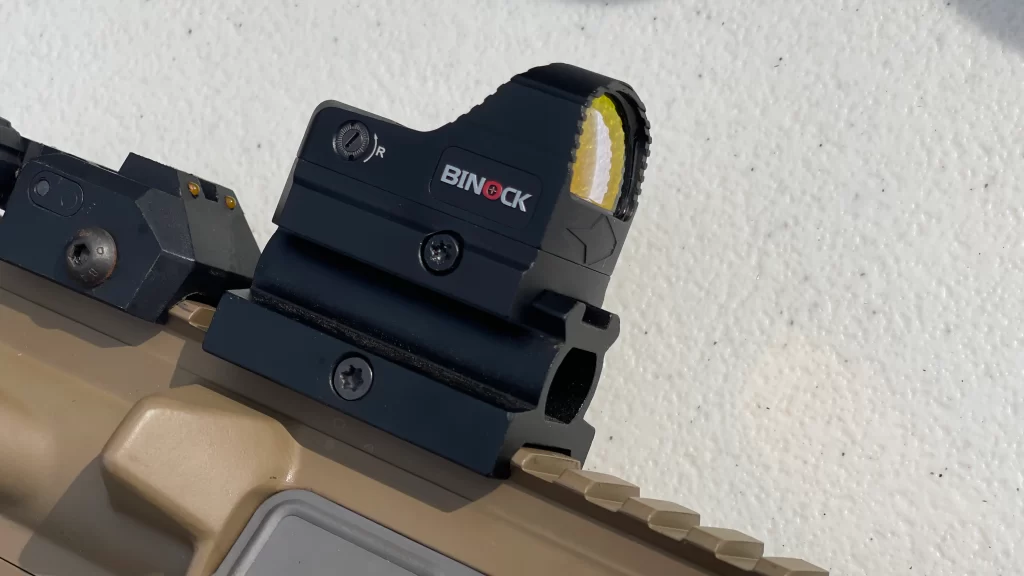
The BINOCK TD01 is a good example of this idea.
It has a compact 1× optical design, a 3 MOA reticle, 10 brightness levels, FMC lens coating, IPX7 waterproof protection, a CR1632 battery, and a lightweight body.
None of these specifications is trying to shout,
“Look how complicated I am!”
And that's kind of the point.
The product has a relatively straightforward concept.
Compact.
Lightweight.
Simple to understand.
Focused on the core optical experience.
For B2B buyers, that can be useful when considering where a product fits within a broader product line.
Not every product needs to be the most feature-packed item in the catalog.
Sometimes a product with a clear concept is easier to position, easier to explain, easier to manufacture, and easier for customers to understand.
And from a sourcing perspective, that's not a small advantage.
The Best Product on Paper vs. The Right Product in Reality
There's a strange habit in product sourcing:
We sometimes try to find the product that wins every category.
Best specifications.
Most features.
Highest numbers.
Lowest weight.
Lowest price.
Maximum customization.
And preferably all at the same time.
Good luck with that one.
Real product development is usually about trade-offs.
You may choose a simpler design because it keeps the product compact.
You may choose a certain feature because it matters to your target market.
You may leave another feature out because the added cost doesn't create enough value.
That's not a compromise caused by poor design.
Sometimes, that's the design.
And this is especially important for OEM and ODM projects.
Customization shouldn't mean changing everything just because everything can be changed.
Good customization means understanding what should change—and what should stay.
So, Should You Stop Looking at Specifications?
Absolutely not.
Specifications still matter.
A lot.
The point is simply that specifications should be understood, not collected.
A good buyer doesn't just ask:
“How many features does this product have?”
They ask:
“Which of these features actually matter to my customers?”
That small change in thinking can completely change how you compare suppliers and products.
Because when every supplier says,
“We can add more features,”
the most useful response might not be:
“What else can you add?”
It might be:
“Why do we need it?”
That question sounds simple.
But sometimes, it leads to a much better product.
Because in the end, a well-designed product doesn't need to have everything.
It needs to have the right things.
Share on Social:


