


What Should You Look for When Sourcing a Red Dot Sight?



You ask a supplier about a red dot sight, and five minutes later, you have a specification sheet full of numbers.
3 MOA.
1×.
IPX7.
FMC.
CR1632.
66.2g.
And then comes the most important question:
“Okay... but what do these actually mean?”
If you're new to optical products, that's a perfectly reasonable question.
A red dot sight looks fairly simple from the outside. A small optical window, a red reticle, a compact housing, and that's about it.
But once you start sourcing them for a brand, distribution business, or product line, things get a little more interesting.
Those small numbers on the specification sheet are not just technical details. Together, they tell you a story about the product's design, positioning, and the kind of market it may fit.
So instead of asking, “Which red dot sight is the best?”, it may be more useful to ask:
“What should I actually look for when choosing one for my market?”
Because in B2B sourcing, the best product on paper isn't always the right product for your customers.
Don't Judge a Red Dot by One Number
There is an easy trap when comparing optical products.
You see one impressive specification and immediately think:
This one must be better.
But red dot sights don't really work that way.
A product with a larger number isn't automatically better, and a product with a smaller number isn't automatically more premium.
A useful red dot sight is the result of multiple specifications working together.
Take BINOCK's TD01 as an example.
Its specification sheet includes:
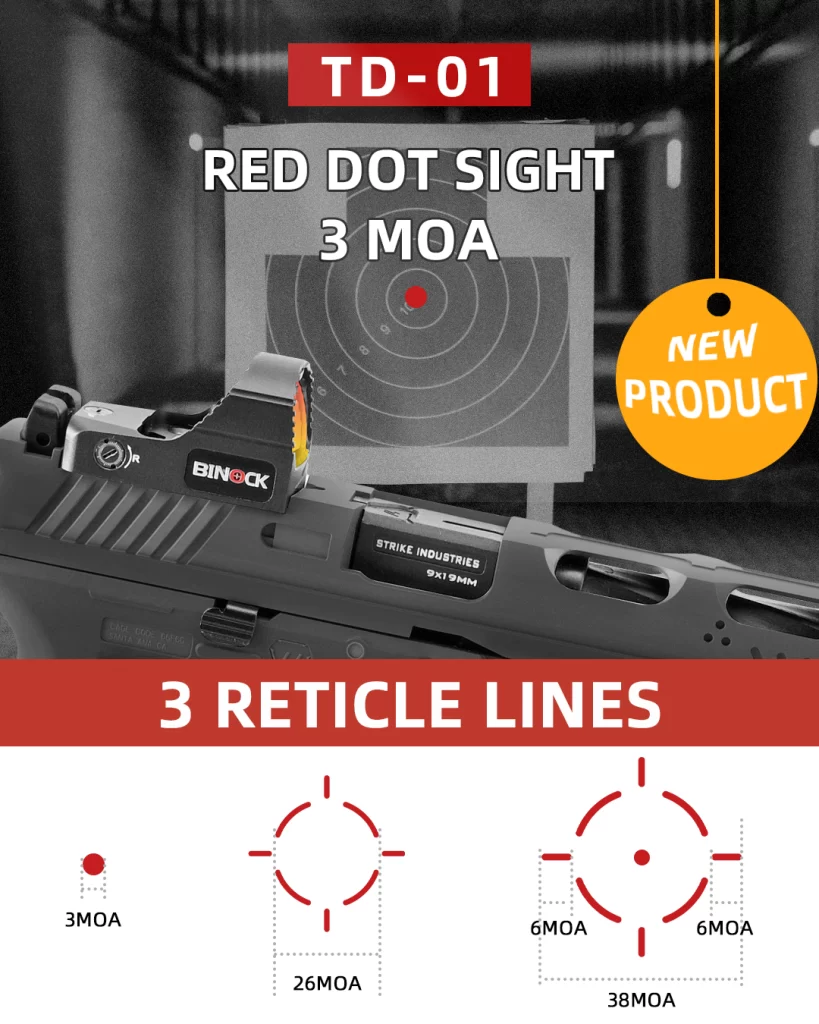
- 3 MOA
- 1× magnification
- 1–10 brightness adjustment
- FMC lens coating
- IPX7 waterproof protection
- CR1632 battery
- 66.2g weight
- 4.4 × 2.7 × 3.9 cm dimensions
None of these numbers tells the whole story by itself.
But put them together, and the product's positioning becomes much easier to understand.
Let's break it down.
What Does 3 MOA Actually Mean?
MOA is one of those terms that appears on red dot specification sheets all the time.
And if you don't work with optics every day, it can look a little intimidating.
In simple terms, MOA is an angular measurement used to describe the apparent size of a reticle or dot.
TD01 uses a 3 MOA configuration.
For a B2B buyer, the important point isn't simply whether 3 MOA sounds bigger or smaller than another number.
The size of the dot contributes to the overall visual experience and product positioning.
And this is where sourcing gets interesting.
There isn't one reticle configuration that automatically makes sense for every market.
Different users may have different preferences, while different product lines may also call for different optical characteristics.
So rather than asking:
“Which MOA number is the best?”
A better question is:
“Which configuration makes sense for the users I'm selling to?”
That is a much more useful question when you're building a product line.
1× Magnification Doesn't Mean “Low Spec”
Here's another specification that can be misunderstood:
Magnification: 1×
Someone unfamiliar with red dot optics might see “1×” and think:
“Only 1×? Is that a basic model?”
Not necessarily.
A red dot sight follows a different design concept from a magnified optical device.
Its purpose isn't simply to make the scene look bigger. The product is built around a straightforward, non-magnified optical viewing experience.
So with a red dot:
1× isn't a limitation. It's part of the concept.
That's an important distinction when comparing different types of optics.
If you're sourcing a compact red dot optic, you shouldn't judge its positioning using the same standards you would use for a magnified scope.
Sometimes simplicity is exactly what the product is designed to deliver.
Brightness Adjustment: Because Lighting Never Stays the Same
TD01 offers 10 levels of brightness adjustment.
At first glance, this may not look like the most exciting specification on the sheet.
But think about how quickly lighting conditions can change.
Indoor and outdoor environments are different.
Overcast weather and bright daylight are different.
Even the same environment can look completely different at different times of the day.
A fixed brightness setting isn't necessarily going to feel the same in all of those situations.
That's why adjustable brightness matters.
The question isn't simply:
“Does it have the highest brightness number?”
It's more about whether the product gives users enough adjustment range to work with different lighting conditions.
TD01's 1–10 brightness adjustment provides that flexibility while keeping the interface relatively straightforward.
It's one of those features that doesn't look particularly dramatic on a product page, but tends to make more sense once you actually use an optical product in different environments.
FMC Lens Coating: The Specification People Often Skip
Now let's talk about something that probably won't win the “most exciting specification” award:
FMC lens coating.
FMC generally refers to Fully Multi-Coated optical surfaces.
If you're not familiar with optics, those three letters may look like another piece of supplier terminology that you can safely skip.
But lens coating plays a role in how light passes through the optical system.
Proper multi-coating can help reduce unwanted reflections and improve light transmission, contributing to overall image clarity and contrast.
It's not the kind of feature you can easily appreciate from a product photo.
You won't look at a picture of TD01 and say:
“Wow, that's some impressive lens coating.”
That's not really how it works.
And that's exactly why it's worth paying attention to.
Some of the details that affect an optical product's experience aren't visible from the outside.
When sourcing optics, the housing and appearance matter, but the optical system deserves attention too.
IPX7: Outdoor Products Need More Than a Tough-Looking Housing
Red dot sights can be positioned for outdoor-oriented and sporting product markets, where environmental resistance becomes an important consideration.
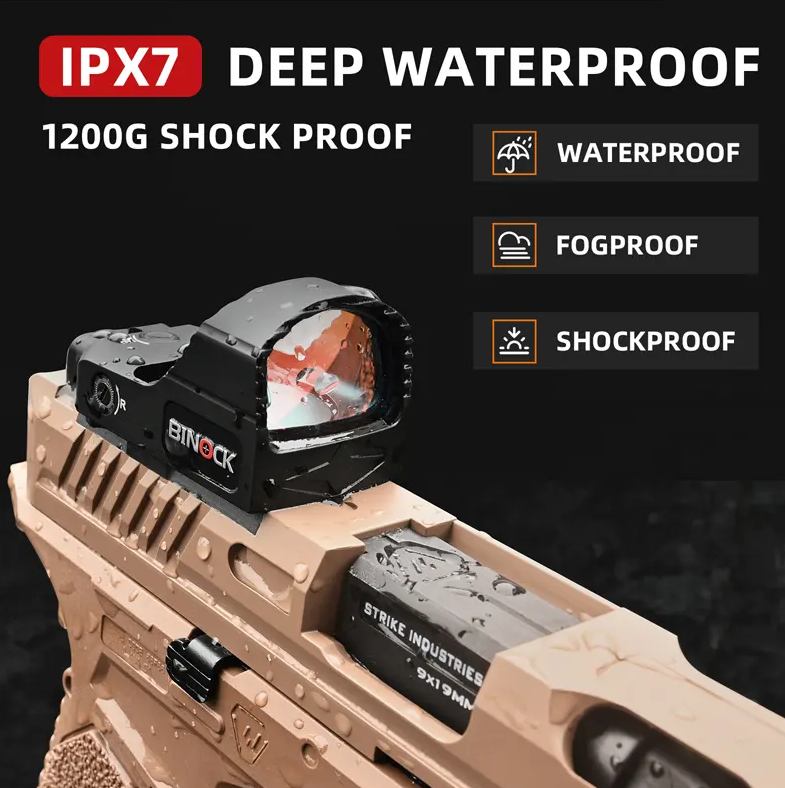
TD01 is rated IPX7 for water resistance.
Under defined testing conditions, IPX7 indicates protection against temporary immersion in water.
For B2B buyers, however, the more useful question isn't simply:
“Is it waterproof?”
It's:
“Does this level of environmental protection fit the market I'm targeting?”
For an outdoor-oriented product line, environmental resistance can be an important part of the overall product proposition.
For another market, other factors may matter more—such as size, weight, appearance, cost, or customization options.
Again, one specification doesn't define the product.
The specifications work together to create the product's positioning.
66.2g: Why Weight Matters More Than It Looks
TD01 weighs 66.2g.
Let's be honest.
Nobody is going to choose a red dot sight simply because “66.2g” looks particularly beautiful on a spreadsheet.
But when a product becomes part of a larger equipment system, weight starts to matter.
A compact and lightweight optical product can be easier to position within product lines where portability and overall size are important considerations.
TD01 also measures just:
4.4 × 2.7 × 3.9 cm
Put the dimensions and weight together, and you get a clearer picture of the product.
Not just two numbers, but a positioning:
Compact. Lightweight. Straightforward.
That's much more useful than looking at the weight in isolation.
CR1632: Yes, Even the Battery Can Become a Sourcing Question
Then there's the battery:
CR1632.
At first, you might think:
“It's just a battery. What's there to discuss?”
If you're buying one product, probably not much.
If you're sourcing hundreds or thousands of units, the question becomes more relevant.
Battery type can affect things such as:
- Replacement convenience
- Market availability
- Packaging
- Accessory management
- Product maintenance expectations
For B2B sourcing, small specifications can eventually turn into very practical questions.
Is the replacement battery easy to find?
Will your customers recognize the battery type?
Does it fit the way you want to package and position the product?
These aren't glamorous questions.
But procurement is full of questions that aren't glamorous—and somehow still end up on the final purchase order.
So, Where Does TD01 Fit?
Once you put all the specifications together, TD01 becomes much easier to understand.
| TD01 Specification | What It Tells Buyers |
| 3 MOA | Compact red dot configuration |
| 1× | Non-magnified optical design |
| 1–10 brightness adjustment | Flexible brightness control |
| FMC lens coating | Designed for improved optical transmission |
| IPX7 | Environmental protection for outdoor-oriented applications |
| CR1632 | Compact battery configuration |
| 66.2g | Lightweight positioning |
| 4.4 × 2.7 × 3.9 cm | Compact form factor |
Individually, these specifications may not look particularly dramatic.
Together, they tell a much clearer story.
TD01 is positioned as a compact and lightweight red dot optic with straightforward optical features and environmental protection.
And that is far more useful information than simply saying:
“We have a 3 MOA red dot sight.”
The product's value comes from the combination.
The Real Question Isn't “Which Red Dot Is the Best?”
If you're a brand owner, distributor, or procurement professional, you may have noticed something by now.
The biggest question isn't really:
“What's the best red dot sight on the market?”
That's simply too broad.
A much better question is:
“What kind of red dot sight makes sense for my market?”
If your customers care about compact equipment, size and weight may matter more.
If your product line is aimed at outdoor-oriented markets, environmental protection may become more important.
If you're building a brand around product experience, optical configuration, brightness adjustment, and overall design may deserve more attention.
And if you're working in a highly price-sensitive segment, cost, supply stability, and production consistency may ultimately have more influence on the buying decision.
That's the reality of B2B sourcing.
A specification doesn't exist on its own. It needs to support a product position.
The equation is much simpler than it looks:
Product specifications × User needs × Market positioning
That's where a product starts to make sense.
Standard Product or OEM/ODM?
This is usually the next question once you've found a product that fits your direction.
A standard product can be a straightforward starting point when you need an existing configuration and a relatively efficient sourcing process.
But if you're building your own brand or developing a more differentiated product line, OEM and ODM options can become much more interesting.
Customization may involve areas such as product appearance, branding, packaging, colors, or selected product specifications, depending on the project.
Because B2B sourcing isn't always about buying an existing product.
Sometimes the real goal is:
“How do I turn this product into something that makes sense for my brand and my customers?”
That's where the manufacturer's capabilities become important.
TD01 can be supplied as a standard BINOCK product, while OEM/ODM cooperation can also be explored for brands and distributors with specific market requirements.
After all, a specification sheet is only the beginning.
The real goal is to turn those specifications into a product that makes sense—and ultimately, a product that makes sense for the market.
Don't Let the Specification Sheet Scare You
The next time a supplier sends you a red dot specification sheet filled with numbers, don't immediately start looking for the biggest number.
Start with three simpler questions:
Who are my customers?
What do they actually care about?
What role should this product play in my product line?
Then look back at the numbers.
3 MOA.
1×.
FMC.
IPX7.
66.2g.
Suddenly, the specification sheet doesn't look quite so intimidating.
Because sourcing isn't really about finding the product with the most impressive list of specifications.
It's about finding the right balance between features, cost, user experience, and market positioning.
The right product doesn't need to win every specification. It needs to make sense for the market.
Share on Social:


- PREV: Thermal Imaging vs. Night Vision: Which One Should You Choose for Your Market?
- NEXT: Not NEXT
